



IPEC China 2025/11/27
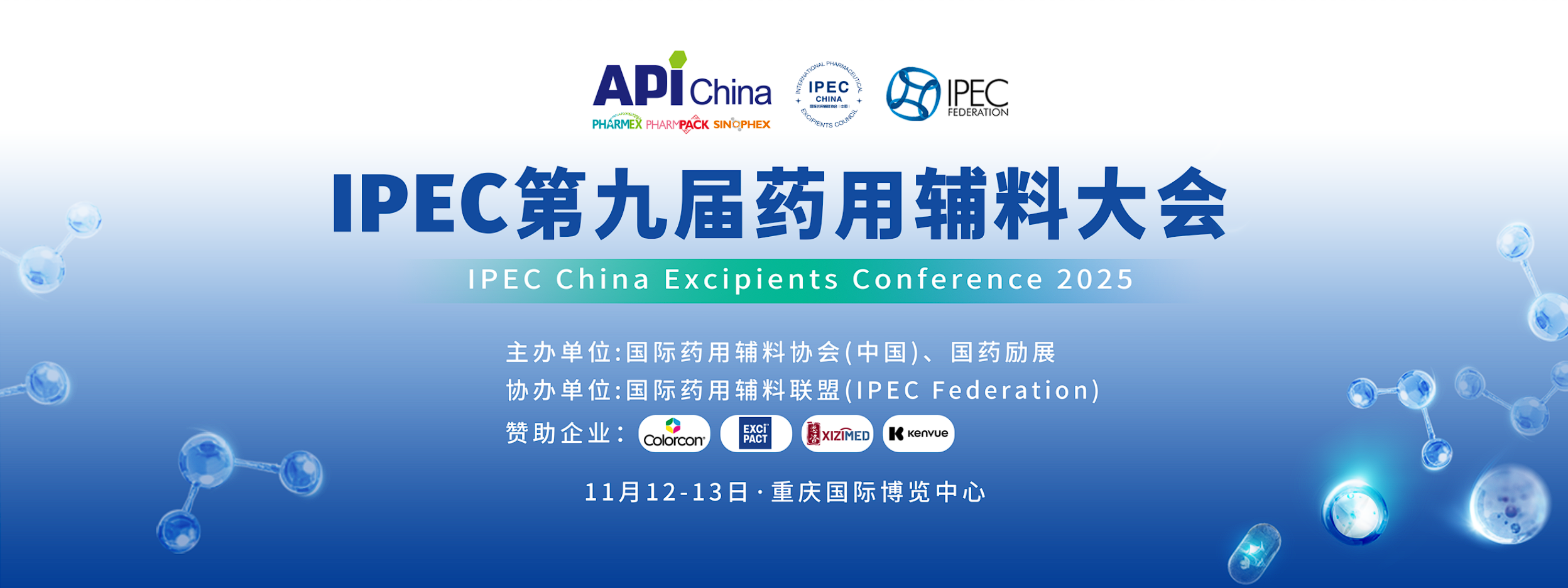
The IPEC China Excipients Conference 2025, co-hosted by IPEC China and Reed Sinopharm Exhibitions, and supported by IPEC Federation, was successfully held in Chongqing on November 12-13, 2025. The conference invited over ten experts from home and abroad, including Sichuan Institute for Drug Control, Guangdong Institute for Drug Control, China Pharmaceutical University, WHO, EDQM, USP, IPEC Federation, IPEC Europe, and IPEC Japan. 16 hot topics were interpreted respectively. Representatives from domestic and foreign pharmaceutical enterprises and manufacturing and operation enterprises for pharmaceutical excipients attended the conference.
Day One of the Conference: Focusing on Standard Harmonization, Compliance Practices and Supply Chain Security
The conference on November 12th was respectively presided over by Cloris Tian , Chair of IPEC China, and Cissy Suming Wang, Vice Chair of IPEC China and chair of the industry sub-committee.
Adrian Bone, Executive Secretary of IPEC Federation, introduced the mission and goals of the IPEC federation respectively and interpreted the IPEC Significant Change Guide in combination with practical cases. In the interpretation of the guidelines, it was pointed out that the formulation of the guidelines aims to establish a unified method for assessing the significance of changes, so as to determine whether the users and regulatory authorities need to be notified by analyzing the potential impact of the changes on the quality of excipients.
Liu Yanming, the former Vice President of Hunan Institute for Drug Control, elaborated on the characteristics of the establishment of the pharmaceutical excipient standards system in ChP2025 from the perspectives of risk and full-process management concepts, research on critical quality control technologies and standard formulation methods, and the coordination of domestic and international standards, meanwhile, introduced the control strategy for elemental impurities of pharmaceutical excipients in ChP2025 and the coordination with ICH Q3D.
Jiang Yan, Director of the Packaging Materials and Excipients Institute of Sichuan Institute for Drug Control, focused on the significance of excipient functionality in the consistency evaluation of generic drugs and discussed the intrinsic connection between excipient functionality and the critical quality attributes (CQAs) of drug products, emphasized analyzing in detail the potential impact of excipient differences on critical indicators such as the dissolution and stability of drug products, and sorted out typical function pathways and risk factors, providing a reference for conducting technical research in consistency evaluation.
Shine Gao, Chair of the Quality Sub-committee of IPEC China, first gave a brief introduction to the GMP regulations for pharmaceutical excipients both at home and abroad, then elaborated on the detailed comparison of the clauses, finally summarized the key differences and the directions for synergy between the two.
Ivy Wang, QA Manager of Shanghai Colorcon Coating Technology Co.,Ltd., under the background of the upcoming implementation of the new version of the Chinese GMP for excipients in 2026, interprets how excipient manufacturers and users can understand and implement the new version of GMP. Starting from the key points of quality management that excipient users are concerned about, she explained the requirements of the new regulations for the construction of enterprise quality management systems, change management, and risk classification research. Combining long-term practical experience in the industry, she shared practical skills such as communication and collaboration between supply and demand and cooperation with drug marketing authorization holders in review.
Rutendo Kuwana, Team Lead of WHO’s Health Systems Division, Prequalification and Regulation Department (RPQ), Market Surveillance and Control team, drawing on insights from the 2025 WHO-UNODC Joint Report, analyzed systemic vulnerabilities in the global high-risk excipient supply chain across procurement, handling, and regulatory processes, particularly emphasized the severe public health threats posed by contaminated excipients to the countries with low- and middle-incomes. Rutendo Kuwana outlined five strategic directions: regulatory reform, enhanced testing capacity, construction of supply chain transparency, international collaboration, and cross-sectoral law enforcement. Rutendo Kuwana also elaborated on WHO's evolving role in market surveillance and called for coordinated actions among health, judicial, and regulatory authorities, so as to prevent potential contamination incidents in the future.
Dr. Dirk LEUTNER,Head of European Pharmacopoeia Department, EDQM-Council of Europe, shared the latest updates of the European Pharmacopoeia (EP), covering the quality requirements of newly added excipients and the revisions of existing standards and other core contents.
Day Two of the Conference: Focusing on Risk Management, Policy Implementation, and Innovative Development
The meeting on November 13 was chaired by Daniel Liu, Chair of the Pharmacopoeia Subcommittee of IPEC China, and Xu Xiaofeng, Director of IPEC China, concurrently Chair of the Regulatory Subcommittee.
Dr. Frank Milek, IPEC European Board Member and Chair of the GDP Committee, provided a detailed overview of risk mitigation measures for key processes—including excipient storage monitoring, transport traceability, and recall of non-conforming products—based on the IPEC Federation 2024 GDP Guideline and WHO's Good Distribution Practice of Pharmaceutical Products (GTDP) Guidelines. He offered feasible risk assessment quantification tools and checklists to assist companies in establishing comprehensive end-to-end risk prevention systems.
Nevin Cheng, Head of Operations ,EXCiPACT asbl-China, addressed the diversity and complexity of pharmaceutical excipients focusing on Establishing and Implementing Effective Risk Assessment Methods. His presentation provided core strategies for enterprises to conduct risk management across all stages—including production, testing, and distribution—thereby enhancing their capabilities in ensuring excipient quality.
Ling Xiao, Director of USP- China, provided an overview of the USP standards for pharmaceutical excipients and the latest development. The presentation, focusing on the USP's cutting-edge perspectives on excipient quality and development, systematically outlined the USP excipient quality standards framework and strategy development, and mainly emphasized on the specification and solutions for starch-based excipients, phospholipid excipients for complex products, and PLG/PLGA excipients.
Chen Ying, Head of the Pharmaceutical Excipients Department at the Guangdong Institute for Drug Control, focused on the application of ICH Q3C in excipient quality control and risk assessment. She systematically interpreted the progress in harmonizing the Chinese Pharmacopoeia's residual solvent standards for pharmaceutical excipients with ICH Q3C across four dimensions. Firstly, she reviewed the historical evolution and core content of ICH Q3C. Secondly, she examined the current implementation status at home and abroad and compared the evolution and key provisions for residual solvent control in the USP, EP, JP, and ChP. Next, she elaborated on the key points for evaluating and controlling excipients and provided an in-depth analysis of the harmonization plan for the ChP standards on pharmaceutical excipients. Finally, she summarized the core value of quality management for excipients and clarified that quality evaluation and control should be guided by formulation requirements. She also highlights the profound impact of introducing and strengthening risk management concepts on industry development and regulatory practices, while outlining prospects for high-quality development in the excipient field.
Li Yinbo, General Manager of Shenyang Xizi Biomedical Technology Service Co., Ltd., reviewed the decade-long development of China's bundling review system for excipients and packaging materials. Drawing on the State Council's Document No. 53 [2024] and the implementation context of the new edition of the Chinese Pharmacopoeia, he provided an in-depth analysis of the core logic, application procedures, documentation requirements, and key review considerations of the bundling review process.
Hiroshi Watanabe,Managing Director of IPEC Japan, first introduced the organizational structure and functions of IPEC Japan. He then elaborated in detail on the definition, current development status, and essential data requirements for new types of excipients in Japan.
Professor Tu Jiasheng from China Pharmaceutical University conducted an in-depth analysis of current R&D opportunities for novel pharmaceutical excipients. He introduced key categories of novel excipients and their applications, explained the preclinical and clinical evaluation systems for new excipient development, and concluded by analyzing challenges in design, safety, characterization, and quality control during the development of novel excipients.
Adrian Bone, representing IPEC America, provided an in-depth interpretation of the core content of the IPEC Excipient Stability Guide. This guideline offers excipient manufacturers a comprehensive stability assessment strategy and methodology for developing research protocols. The resulting data can support regulatory submissions, provide scientific basis for determining excipient storage conditions and shelf life, and assure pharmaceutical end-users that excipients consistently meet specifications or pharmacopeia requirements throughout their shelf life.
This conference featured multiple Q&A sessions where attendees engaged in in-depth discussions with experts on practical challenges encountered in the field, such as details of pharmacopoeia harmonization, difficulties in implementing GMP, and the application of risk assessment tools.
The IPEC China Excipients Conference 2025 aims to establish a communication platform for exchange and cooperation in the pharmaceutical excipient industry, fostering development and dialogue both domestically and internationally. It seeks to enhance information sharing and collaboration among research institutes, industry associations, pharmaceutical manufacturers, and excipient enterprises. Concurrently held with the 93rd API Exhibition, the conference creates a comprehensive exchange platform for upstream and downstream enterprises while providing professionals with opportunities for technical sharing. This initiative advances the pharmaceutical excipient industry's development toward standardization, compliance, innovation, and internationalization.
IPECCN


